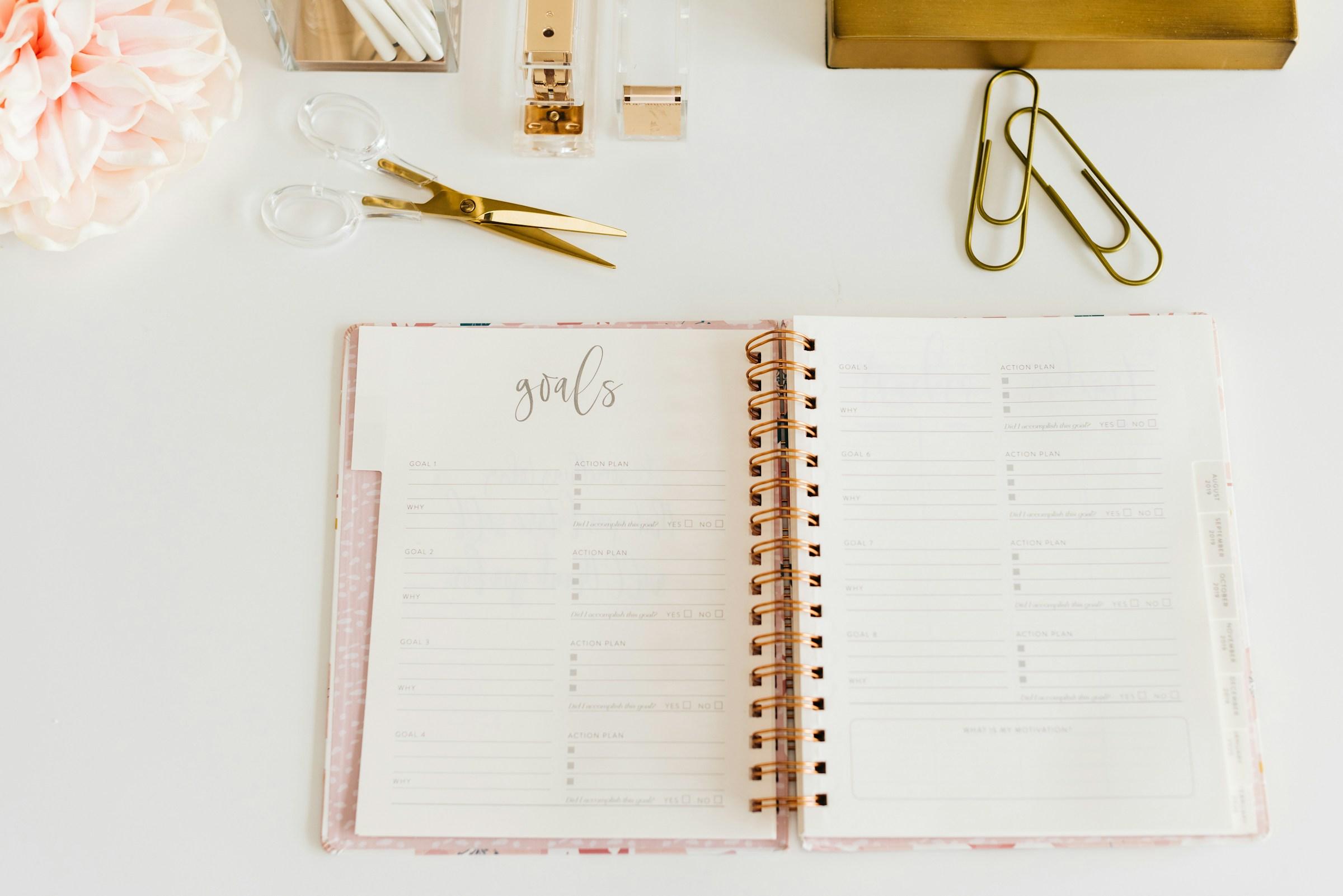
December arrives and, along with the holidays, comes the urge to look back. What went well and what was left along the way. The trouble is that our memory of the year tends to be unfair: the last months weigh more, and what happened in March feels like it was in another life.
To do your year in review, look area by area at what happened and what depended on you, and only then write down what you take into the next year. And you can predict your moment in the year ahead. Vedik uses Vedic astrology, through the KP method (created by K. S. Krishnamurti), to read in your birth chart the phases in which you lived this year and in which periods of 2027 each subject gains strength.
How to do your year in review in four steps
- Gather your records. Calendar, statements, photos and messages. Memory fails, and records show what happened.
- Build the timeline. For each month, one or two facts that stood out: a change, a conversation, a project, a loss.
- Look area by area. Work, money, relationships, home and studies. For each one: what happened, what depended on you and whether you keep it or leave it for 2027.
- Close with decisions. Three things to take along, one to leave behind and one conversation that needs to happen.
A simple table organizes step 3:
| Area | What happened | What depended on me | Keep or leave |
|---|---|---|---|
| Work | |||
| Money | |||
| Relationships |
Questions that help fill it in:
- What am I most proud of this year, even if nobody saw it?
- What did I plan and not do? Do I still want it, or has the goal lost its meaning?
- Which decision did I put off that still needs an answer?
- In which months did things move more easily, and in which did everything stall?
Avoid giving the year a score. A score packs everything into one number and hides what the review wants to show: that each area moved in its own way. To turn the review into decisions, use one criterion per item: take into 2027 what still makes sense and has a possible next step, and leave what you only keep out of habit.
The question about the months becomes a test with your phases. Put your phases, which the free reading shows, next to the months of your year and see which phase you were in when things moved and when they stalled. Sometimes the comparison explains a lot: work changed in one phase, and money only moved in the next. Sometimes it explains nothing, and that is information too. The exercise shows the method in your own year, with your own facts, before you use it for the next one. To check a prediction carefully, see how to verify an astrological prediction.
With the review done, write your 2027 list on one page: the three things you take along, each with its next step and the month you want to start, the conversation that needs to happen, with a date, and three or four dates in the year to review the list. To order your priorities across the year, read personal planning for 2027.
How Vedic astrology reads the year that went by
Your birth chart is a snapshot of the sky on the day, at the time and in the city where you were born. It is divided into twelve parts, called houses, and each subject of life is read through some of them. Your calendar comes from the same chart: life runs in cycles, each cycle has phases and each phase has subphases, each ruled by a planet. Vedik's KP engine calculates this chart and this calendar from the date, time and place of your birth.
A year rarely moves the same way in every area, and the book helps explain why. In KP Reader III, p.362, an article reprinted in the book shows that, within the same major period, in one subperiod a person may be employed, in another stay idle, in another do business, in another have gains and in another lose. A year holds several subphases, and each one can link to different subjects.
The timing rule comes from a case in KP Reader VI, p.189: the result comes when the planets of the three periods the person is running are significators of the houses of the subject. At Vedik, a period favors a subject when the planets of your cycle, your phase and your subphase are linked to its houses. Money, for example, is read through houses 2, 6, 10 and 11 (KP Reader III, p.204). When one of the three planets is missing, the period appears as PREPARE for that subject.
The sky of 2027 is the same for everyone, and the dates are in the 2027 predictions. What decides your months is your periods.
What Vedik shows for your review and for 2027
- Free reading, when you create your account: your chart profile, your cycles and your phases. This is what you put next to your timeline.
- VedikAI: the question of the moment, about days and weeks, answered from your chart and your periods. "Does the phase starting now favor work or money?", "is January good for that postponed conversation?". Each question uses 1 credit, and a new account gets 3 credits.
- 2027 Report: the year subject by subject, such as money, new work, business, romance and moving to another city, with your chart's answer (YOUR CHART FAVORS IT, DOES NOT FAVOR IT, A YEAR TO PREPARE or DOES NOT DEFINE IT) and the months marked FAVORABLE or PREPARE, with what to do and avoid.
The report plans the year, and VedikAI helps with the decision of the day.
If the review left the feeling of a heavy year, see when will my life get better.
Where to start
Set aside an afternoon, build the timeline and open the free reading next to it. For the question that remains, ask VedikAI. The final word is always yours.