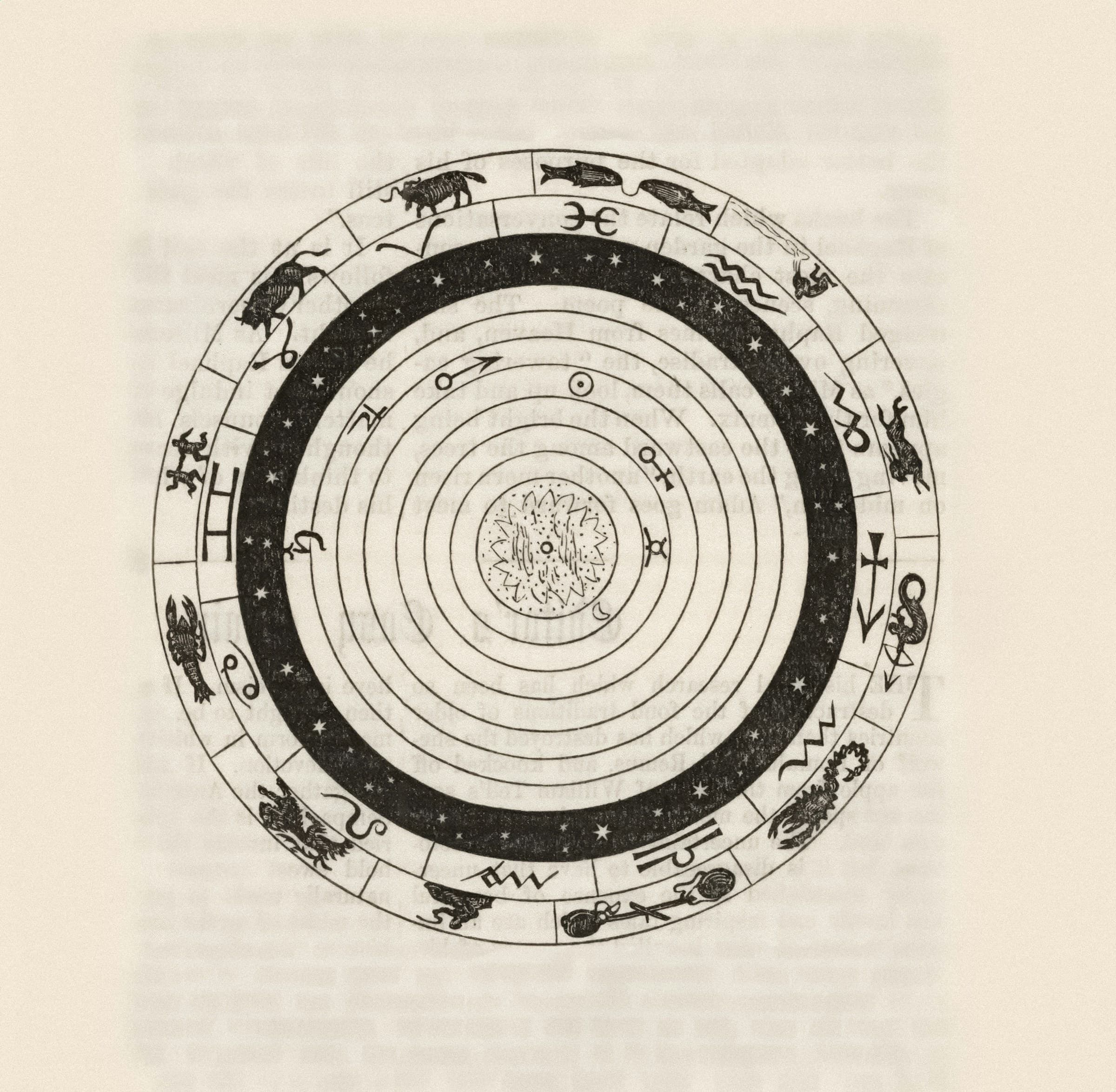
Astrology began in Mesopotamia almost four thousand years ago as a way of reading signs in the sky for the king and the kingdom. The birth chart of an individual only appeared in the 5th century BC, in Babylonia, and gained the ascendant and the houses in Egypt under Greek rule. From there it traveled to India, to the Islamic world and to Europe, and in the 20th century it reached the pages of newspapers.
Mesopotamia: the sky as a message for the king
The first organized texts on reading the sky are Babylonian, from around 1800 BC. Priests watched the Moon, the Sun, the planets and eclipses and recorded what happened in the kingdom after each sign.
These records became a large collection, the Enuma Anu Enlil, compiled by the 16th century BC. It consists of 70 clay tablets in cuneiform script, with about 7,000 omens.
In this period, astrology looked at the collective. The question was what the sky said about the king, the harvests, wars and the well-being of the people. Nobody made a chart for an ordinary person.
It was also in Babylonia that the division of the sky into 12 parts of 30 degrees appeared, the basis of the zodiac. It was only refined after the fall of the Babylonian empire, in 539 BC. By the 4th century BC, astronomers in the region could already calculate the positions of the planets in advance.
The first chart of an individual
In the 5th century BC, the reading of the sky moved from the kingdom to the individual. The oldest horoscopes we know of date from 410 BC and come from the cities of Babylon and Nippur. They record where the Moon and the planets were at the birth of a child.
Francesca Rochberg, who studies Mesopotamian astronomy, gathered and translated the cuneiform horoscopes that survived. They show the same logic as the ancient omens, now applied to the life of one person.
Greek Egypt: the ascendant is born
In 332 BC, Alexander the Great conquered Egypt. The city of Alexandria became a meeting point for Babylonian, Egyptian and Greek knowledge.
Between the end of the 2nd century and the beginning of the 1st century BC, the astrologers of Alexandria combined the Babylonian zodiac with the Egyptian decans, a division of the sky into 36 parts. From this mix came chart astrology as we know it, with:
- The ascendant, the point of the zodiac rising on the horizon at the time of birth.
- The 12 houses, each one tied to an area of life.
- The planets in the signs, read for one person and one moment.
The word horoscope itself comes from this period. In Greek, hōroskopos means "marker of the hour", and it was the name of the ascendant.
Astrologers of the time attributed the origin of the system to Hermes Trismegistus and to the teachings of the pharaoh Nechepso and the priest Petosiris. The texts that reached us are by authors such as Dorotheus of Sidon and Vettius Valens. In the 2nd century AD, Claudius Ptolemy wrote the Tetrabiblos, which became the foundation of Western astrology.
The journey to India
In the 2nd century AD, a Greek treatise was translated into Sanskrit under the name Yavanajataka, "the sayings of the Greeks". In India, the chart met an ancient tradition of timekeeping, Jyotisha, and the lunar stars, the nakshatras. Vedic astrology came from this combination. We tell this part in detail in what the Vedas are and where Vedic astrology came from.
Baghdad and the Islamic world
In the 8th century, under the Abbasid caliphate, Baghdad brought translators together at the Bayt al-Hikma, the House of Wisdom. Greek, Persian and Indian texts were rendered into Arabic, and astrology continued to be studied and expanded in the Islamic world between the 7th and 13th centuries.
The best-known name of this period is Abu Ma'shar, who lived from about 787 to 886. His books were read in Europe for centuries.
Europe: from translations to universities
In the 12th century, Europe began translating texts on astronomy and astrology from Arabic into Latin. Ptolemy's Tetrabiblos got a Latin version in 1138, by Plato of Tivoli. By the 13th century, astrology was already part of the study of medicine.
In the 17th and 18th centuries, the new astronomy changed the way the sky was explained, and astrology lost the place it had held in the science of the time. It stayed alive outside academia, in books, almanacs and consultations.
20th century: the newspaper and the method
In August 1930, the British newspaper Sunday Express wanted to publish the chart of Princess Margaret, who had just been born. The astrologer R. H. Naylor wrote it. The piece came out on August 24, three days after the birth, and was so successful that the paper asked for more predictions. Soon after, the column began to be organized by the 12 sun signs. This was the start of the newspaper horoscope we know today.
The newspaper horoscope uses only the Sun sign. The chart uses the whole sky at birth. See the difference in horoscope vs. birth chart.
In the same century, in India, the astrologer K. S. Krishnamurti (1908-1972) created the KP system, which starts from the Vedic base and divides the sky into smaller parts to answer whether an event happens and when. Learn more in who Krishnamurti was.
Timeline
| Period | What happened |
|---|---|
| Around 1800 BC | First Babylonian texts on reading the sky |
| By the 16th century BC | Compilation of the Enuma Anu Enlil, with about 7,000 omens |
| After 539 BC | 12-sign zodiac refined in Babylonia |
| 410 BC | The oldest birth horoscopes we know of |
| 2nd and 1st centuries BC | Alexandria creates the chart with ascendant and houses |
| 2nd century AD | Ptolemy's Tetrabiblos and the translation of the Yavanajataka in India |
| 8th century | Translations in Baghdad, at the House of Wisdom |
| 1138 | Tetrabiblos translated into Latin |
| 1930 | First horoscope column in the Sunday Express |
| 20th century | K. S. Krishnamurti creates the KP system |
What this history leaves us
Each era added a layer. Mesopotamia gave sky observation and the zodiac. Alexandria gave the chart of an individual, with ascendant and houses. India added the nakshatras and the cycles of time. The Islamic world and Europe preserved and expanded this knowledge.
Vedik comes from this line. Our own engine calculates the position of the planets at the minute of your birth, and the KP method reads the periods of your chart. The tradition provides the method. The last word is always yours.
Reference works
- Francesca Rochberg. Babylonian Horoscopes. Philadelphia: American Philosophical Society, 1998.
- Francesca Rochberg. The Heavenly Writing: Divination, Horoscopy, and Astronomy in Mesopotamian Culture. Cambridge: Cambridge University Press, 2004.
- Nicholas Campion. A History of Western Astrology, volume 1: The Ancient and Classical Worlds. London: Continuum, 2008.
- David Pingree. The Yavanajātaka of Sphujidhvaja. Cambridge (USA): Harvard University Press, 1978.
The dates and attributions in this text follow what these authors and other researchers have published, as compiled in reference encyclopedias.