Rahu and Ketu are the lunar nodes: the two points where the Moon's orbit crosses the apparent path of the Sun in the sky, the ecliptic. They have no physical body, and even so they're among the strongest factors in Vedic astrology. In the KP method, the nodes work as agents: they deliver the results of other planets, and they do it with more strength than those planets.
Where the two points come from
The Moon's orbit is tilted relative to the ecliptic. The two planes cross along a line, and the two ends of that line, projected onto the sky, are the nodes. The north node, where the Moon rises, is Rahu. The south node, where it descends, is Ketu. That's why the two are always on opposite sides of the chart, 180 degrees from each other.
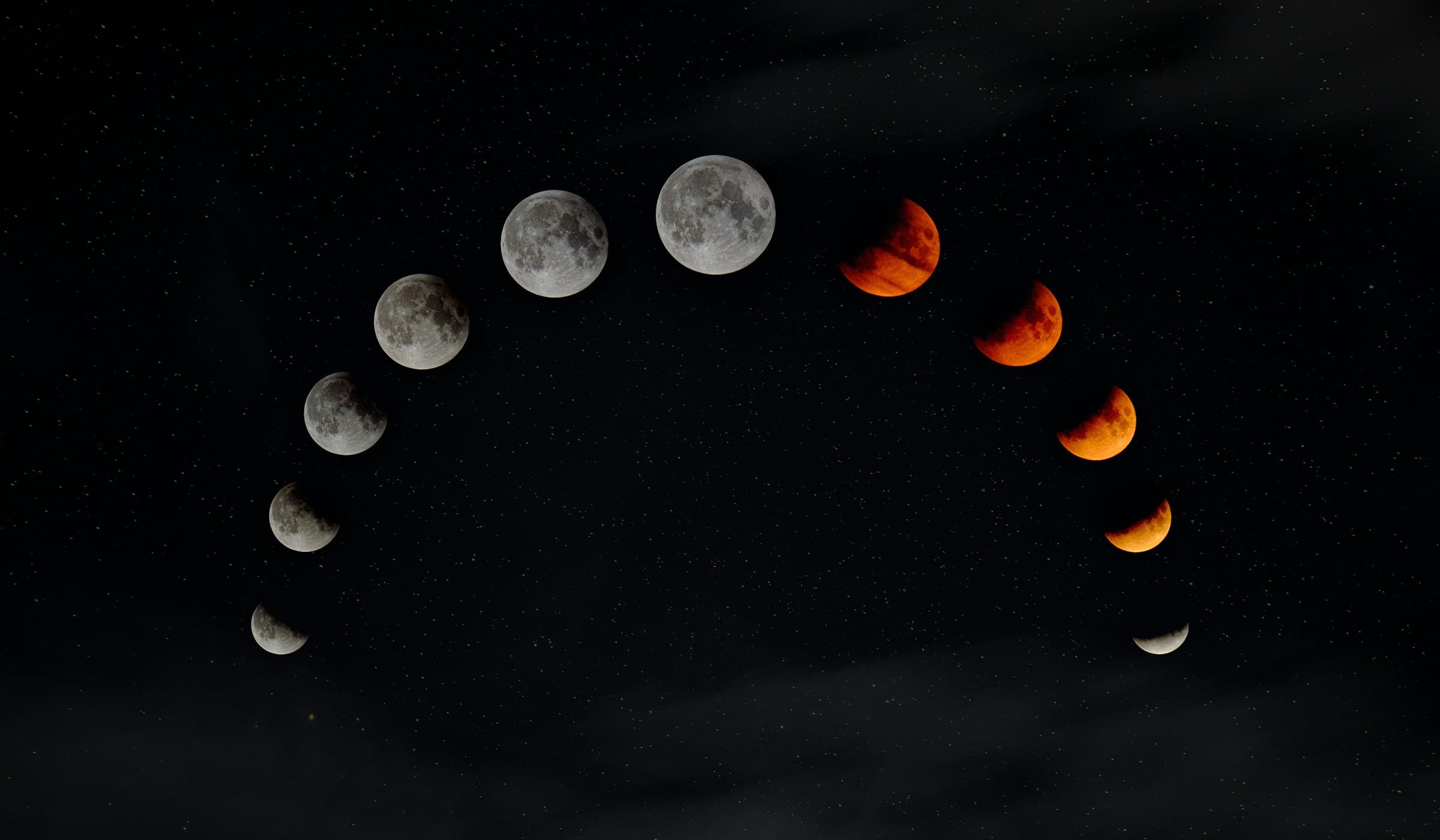
Eclipses happen near this axis. When the Sun and Moon line up close to the nodes, one covers the other. The tradition has always given weight to these points, and astronomy confirms that they mark a special place in the sky.
The nodes move backward through the zodiac, in the opposite direction from the planets, and take about 18 and a half years to complete a full circle.
Mean node and true node
There are two ways to calculate the position of the nodes. The mean node follows the smoothed motion of the axis, always backward. The true node tracks the small oscillations of the lunar orbit and, for a few days, can even seem to move forward. The difference between the two can reach almost two degrees.
Vedik uses the mean node, calculated with the Swiss Ephemeris and Krishnamurti's own ayanamsa. If you compare your chart with another calculation and Rahu shows up at a different degree, this is the first setting to check, along with the ayanamsa.
What the tradition associates with Rahu and Ketu
Vedic astrology associates Rahu with desire, ambition, foreign things and experiences that break from the familiar. Ketu is associated with detachment, withdrawal and inner searching. These associations help convey the general tone of each node and have value within the tradition.
In Vimshottari, the system of periods that divides life into phases, Rahu rules 18 years and Ketu rules 7 (K. S. Krishnamurti, KP Reader I, p. 82). Anyone living through one of these major phases, called mahadasha, feels the node's tone over years.
How KP reads the nodes
This is where Krishnamurti's method gets very precise. Since the nodes have no sign of their own, they act on behalf of other planets. KSK defines the order in which a node delivers results:
- First, the results of the planet or planets the node is conjunct with.
- Then, those of the ruler of the star (nakshatra, each of the 27 divisions of the zodiac) the node is in.
- Next, those of the planets that aspect the node.
- Finally, those of the lord of the sign it's in.
This order is in K. S. Krishnamurti, KP Reader VI, p. 276. In the same book, p. 134, he gives a direct example: Rahu, being in Saturn's sign, acts as Saturn's agent.
And there's a detail that changes the reading. When a node represents a planet, KSK treats it as stronger than the planet itself. The phrase "nodes are stronger than planets" appears more than once in KP Reader III (pp. 195, 327 and 356). In practice, this means a Rahu period can strongly deliver the themes of Saturn, Venus or whichever planet it represents in your chart.
What this changes in your reading
A Rahu phase doesn't have a fixed meaning for everyone. For one person, Rahu may be acting through planets that signify work, and the period tends to bring a professional change. For another, it may represent planets tied to home or relationships. The starting point is always finding out whose agent the node is in your chart.
The same goes for Ketu. The tone of detachment the tradition describes does show up, and it takes direction from the planets it represents. The guide to house significators shows how the houses come into this calculation.
Where to see the Rahu and Ketu phases
Your reading shows which major phase and which sub-period you're in right now. The pages on the Rahu phase and the Ketu phase explain what the method associates with each one. And for a concrete subject, you can ask VedikAI what your period indicates, with the answer to "when" given in month and year. The final word on what to do with it is always yours.
To find out whose agents Rahu and Ketu are in your chart, create your free reading.