The ayanamsa is the distance, in degrees, between the tropical zodiac and the sidereal zodiac. There are different values for it, and the best known in Vedic astrology are Lahiri's and Krishnamurti's. Today the two differ by about 6 minutes of arc, enough to change a sub-lord in KP.
Why there are two zodiacs
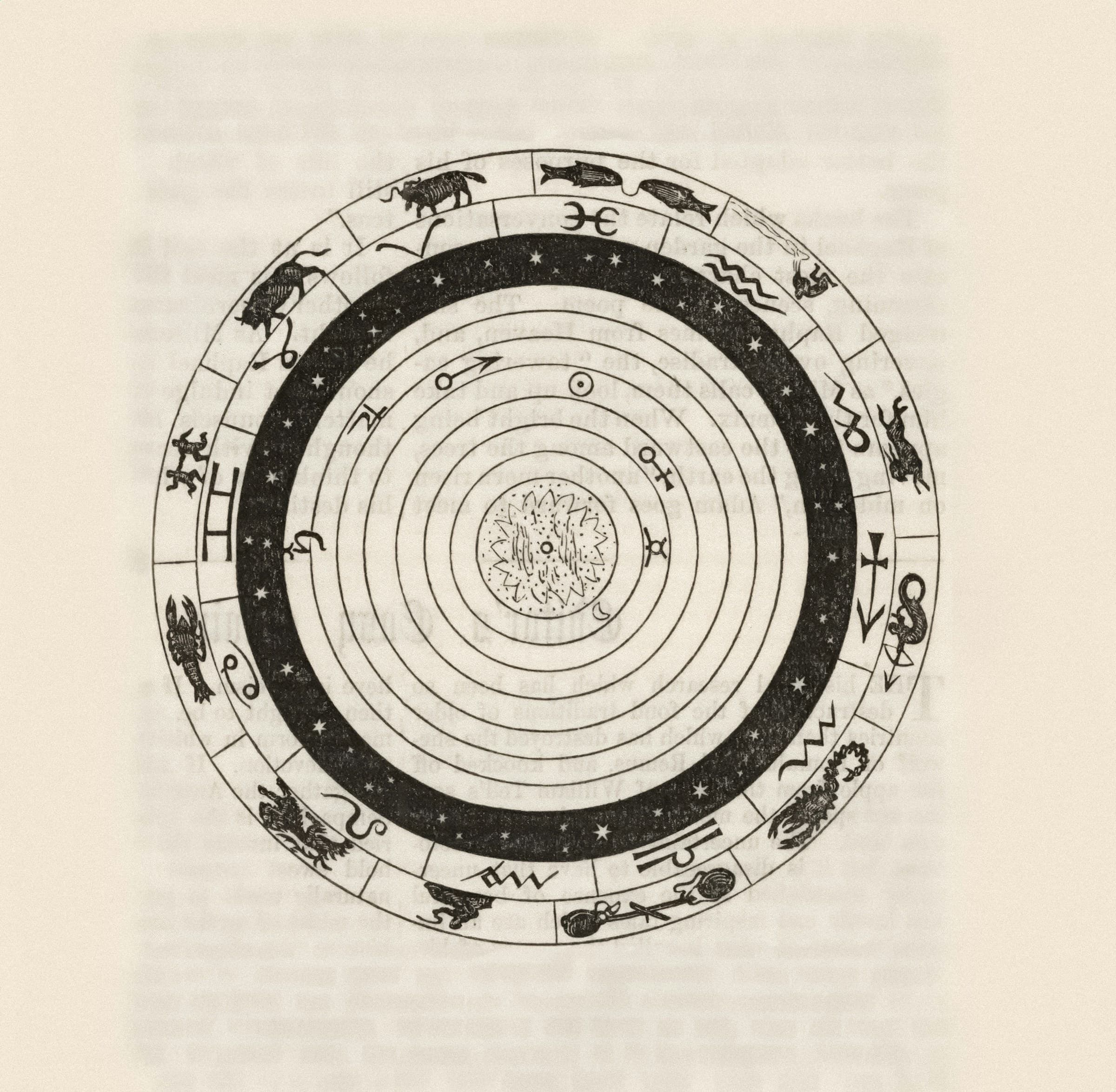
The tropical zodiac begins at the March equinox, the point where the Sun crosses the celestial equator. The sidereal zodiac is tied to the stars. The Earth's axis turns slowly, like a spinning top, and so the equinox moves back relative to the stars by about 50 seconds of arc per year. This movement is called precession.
The ayanamsa measures how far apart the two zodiacs have already drifted. The math is simple: sidereal position is tropical position minus the ayanamsa. In 2026, Krishnamurti's ayanamsa is over 24°.
To arrive at that number, each school defines two things: the year in which the two zodiacs coincided and the speed of precession.
Krishnamurti's ayanamsa
K. S. Krishnamurti published both of his choices.
- Year of coincidence. In his table, the two zodiacs coincide in the year 291 by Krishnamurti's reference and in the year 285 by Lahiri's (KP Reader I, p. 56).
- Speed. He adopts Newcomb's precession, 50.2388475 seconds of arc per year (KP Reader I, p. 57).
With these two choices, he arrives at annual values that appear in the examples in his books: 22°51′ in 1935 (KP Reader I, p. 132) and 23°20′ in 1970 (KP Reader VI, p. 97).
Krishnamurti himself wrote that the difference between his reference and Lahiri's is negligible (KP Reader I, p. 57). Even so, for those who practice KP, his instruction is to use his own (KP Reader VI, p. 243).
How much it changes in practice
We calculated both references in the Swiss Ephemeris, the ephemeris Vedik uses. In 1970, in 2000 and in 2026, Lahiri is about 5.8 minutes of arc ahead of Krishnamurti. In 1970, Krishnamurti's reference gives 23°20′, the same value as in the book.
What 6 minutes of arc change depends on the level:
| Level | Size | Effect of 6′ |
|---|---|---|
| Sign | 30° | Changes only if the planet is right at the boundary |
| Nakshatra | 13°20′ | Changes only if the planet is right at the boundary |
| Sub | from 40′ to 2°13′20″ | Can change the sub-lord of planets and cusps near the limit |
In the sign and the nakshatra, switching references almost never shows. In the sub, 6′ is equal to 15% of the smallest sub, the Sun's. A planet or a cusp near a limit can change sub-lord. Since KP reads the sub, the ayanamsa counts.
The switch also shifts the dates of the periods. The balance of the first dasha comes from the fraction of the star the Moon still has to travel at birth (KP Reader I, p. 87). If the Moon is in a star ruled by Venus, 6′ more or less changes that balance by 20 × 6 ÷ 800 = 0.15 year, about 55 days. All the following dates move along with it.
Lahiri and Krishnamurti, each in its place
Lahiri is a widely used reference in Vedic astrology, and many astrologers have worked with it for decades. Krishnamurti built KP with his own and published the numbers. To read a chart through KP faithfully to the method, the right reference is Krishnamurti's.
Which ayanamsa Vedik uses
Vedik uses Krishnamurti's ayanamsa, in mode 5 of the Swiss Ephemeris. Houses follow Placidus, as in the examples in his books, and the lunar nodes are calculated by the mean node.
How to compare two charts
If two programs show different positions for the same birth, check the settings before comparing the texts:
| Item | What to check |
|---|---|
| Date and time | Did both receive exactly the same data? |
| City | Do the coordinates match the right city? |
| Time zone and daylight saving time | Was local time converted to universal time the same way? |
| Ayanamsa | Is the sidereal reference the same? |
| Houses | Is the house system the same? |
| Lunar nodes | Do both use the mean node or do both use the true node? |
Compare the numbers first: degrees, cusps and settings. Then compare the interpretation. Starting with the texts leads to blaming the calculation for a difference that came from the writing.
Want to see your chart calculated with Krishnamurti's ayanamsa? Create your free reading.