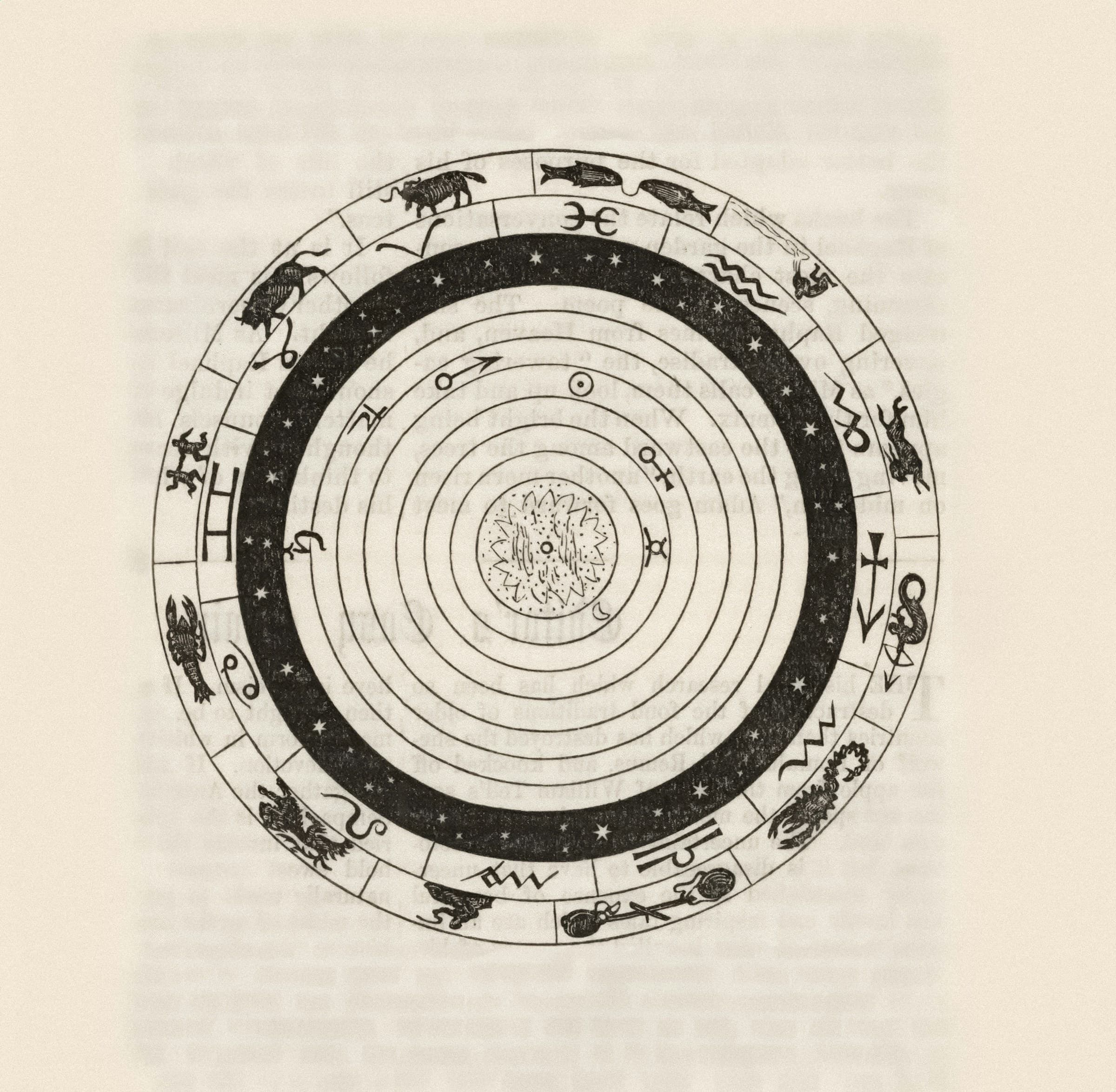
Every time "Mercury retrograde" goes viral on social media, people who know Vedic astrology ask the same question: does that date apply to the Indian system too? It does. Retrogradation is a phenomenon of the sky, with the same date in any system. What changes is the weight each method gives it, and in the KP method that weight is quite specific.
What retrogradation is
Retrogradation is the impression that a planet is moving backward in the sky, as seen from Earth. Earth and the other planets orbit the Sun at different speeds. When Earth overtakes a slower planet, or is overtaken by a faster one, such as Mercury and Venus, the relative position creates this illusion of reverse motion for a few weeks.
It is a fact of celestial mechanics, observed from the same place, Earth. That is why the start and end dates are the same in any astrological system: they depend on the apparent speed of the planet, and the zodiac used to name the position does not affect them.
Not every planet goes retrograde the same way
The frequency varies a lot between planets:
- Mercury goes retrograde more often than any other planet used in astrology, about three to four times a year, for roughly three weeks each time. That is why the topic keeps coming back on social media.
- Venus goes retrograde about once every 18 months, for about 40 days.
- Mars goes retrograde roughly every two years, for up to 10 weeks.
- Jupiter and Saturn, which are slower, go through a retrograde period practically every year, of 4 to 5 months each.
- The Sun and the Moon are never retrograde.
- Rahu and Ketu, the lunar nodes, always move in the same direction, opposite to the planets, and never turn back. That is why, in KP, they are treated as never retrograde (KP Reader VI, p.105).
This variation changes how to read the headlines. A Saturn retrograde, which happens for a good part of every year, carries less urgency than it usually seems.
The shadow period
Many people also talk about the shadow period: the weeks before the retrogradation, when the planet slows down and approaches the point where it will move back, and the weeks after, until it passes again, in direct motion, through the point where it had stopped. This is also orbital geometry, the same in any system.
What the KP method says about retrograde planets
In the birth chart, Krishnamurti is direct: it does not matter whether the planet is direct or retrograde, there is no difference (KP Reader VI, p.145). A retrograde planet in your birth chart does not lose strength or cause harm because of it.
Retrogradation carries weight somewhere else: in the reading of the moment of the question. Among the planets that rule that instant, the so-called ruling planets, a retrograde one indicates delay. The matter tends to wait until the planet returns to direct motion. On the same page, the book says to discard the rulers that are in the constellation of a retrograde planet (KP Reader VI, p.123).
The zodiac reference
Western astrology uses the tropical zodiac, tied to the seasons of the year. Vedic astrology uses the sidereal zodiac, aligned with the fixed stars. Each system is consistent with its own reference, and a chart is always read by the rules of the system in which it was calculated.
How Vedik handles retrogradation
Vedik calculates your chart with the KP method, using the sidereal zodiac and Krishnamurti's own ayanamsa. Following the book, the retrogradation in your birth chart does not change the reading. It comes into play in the ruling planets of the moment you ask: a retrograde ruler indicates delay.
---
Want to know what your current phase shows, and when each matter tends to happen? Read your moment.