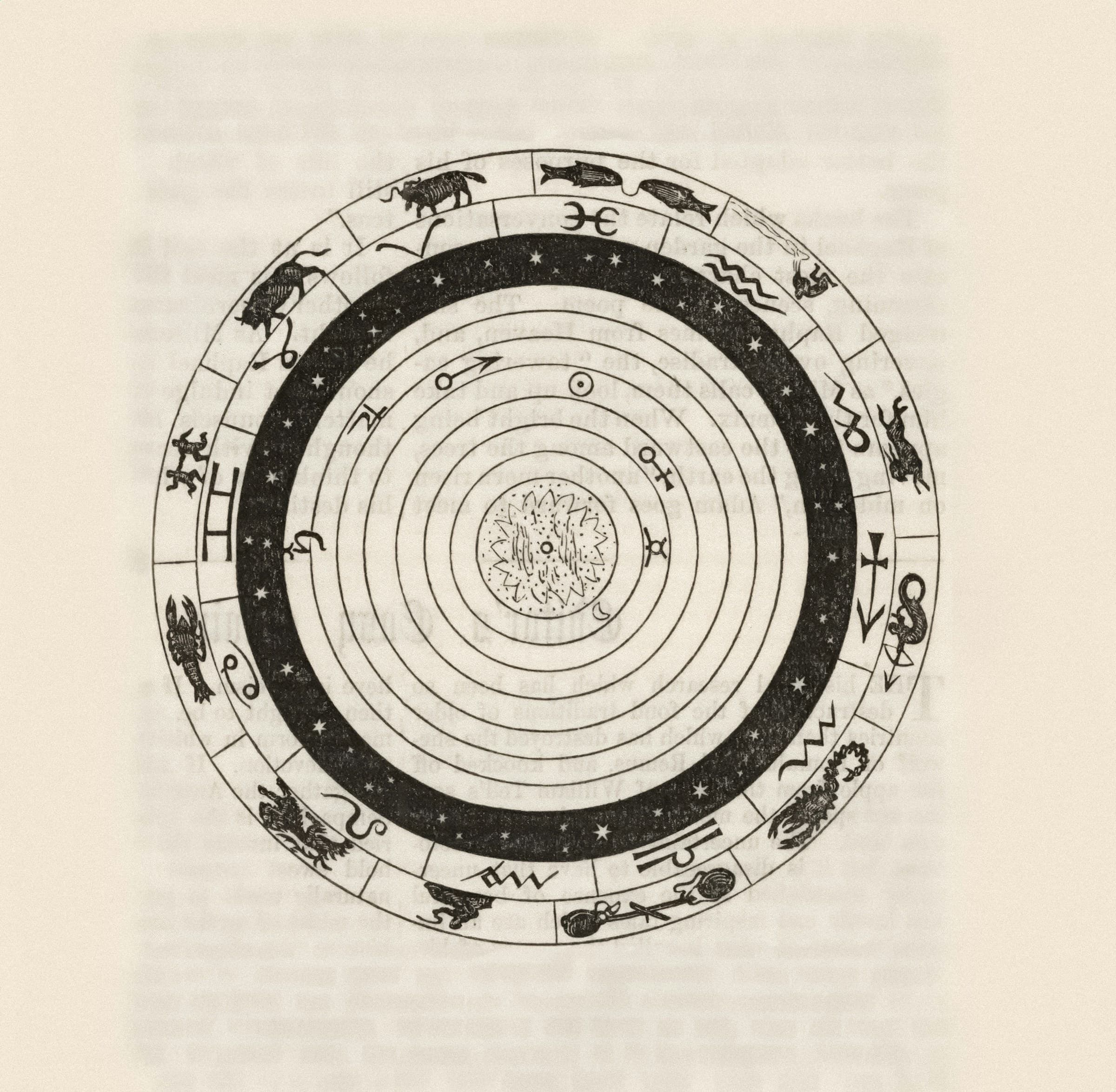
Sign and house are two different divisions of the chart. The sign, or Rashi, always spans 30° and begins at fixed points of the zodiac. The house, or Bhava, begins at the cusp calculated for the time and place of birth and runs to the next cusp. KP calculates the cusps with the Placidus system, which is why the houses have different sizes and a planet can fall in a house that counting sign by sign wouldn't give.
Rashi and Bhava
K. S. Krishnamurti separates the two in KP Reader I. There are twelve signs, they always begin at 0° Aries and each one spans exactly 30°, at any latitude. The houses begin at the point of the zodiac rising in the east at that moment. Each house has a different extent: some go beyond 30°, others fall short, and together they add up to 360° (KP Reader I, p. 44).
So "Venus in Leo" and "Venus in the 10th house" are two pieces of information. One says which sign Venus is in. The other says which house it falls in for that chart.
Why KP uses Placidus
Krishnamurti lists the house division methods he knew. He notes that in India the most popular is that of Sripati Paddhati and describes eight methods used in other countries (KP Reader I, p. 42). About one of them he writes: "The method in common use is that followed by Placidus, generally known as 'Semi Arc System'" (KP Reader I, p. 43). He then recommends Raphael's tables of houses, calculated by Placidus, to save work and avoid error (KP Reader I, p. 43). The examples in KP Reader VI always use these tables.
The name semi-arc comes from the calculation. Each degree of the zodiac takes some time to rise from the horizon to the midheaven. Placidus divides that time into three equal parts, and the cusps fall at those points. Since the degrees rise at different speeds, the houses come out unequal.
The cusp is the beginning of the house
In the tables, the positions given for houses 10, 11, 12, 1, 2 and 3 "are the exact points where the houses begin" and are called cusps (KP Reader I, p. 44). The other six come from adding 180°. A house runs from one cusp to the next: the 11th house extends from cusp 11 to cusp 12 (KP Reader I, p. 82).
The book's example, checked
Krishnamurti gives an example for Madras, at 13° north latitude, with a sidereal time of 18 hours. The ascendant falls at 0° Aries, cusp 2 at 4° Taurus and cusp 3 at 4° Gemini (KP Reader I, p. 44).
We redid the calculation with the Swiss Ephemeris, using Placidus. The cusps come out at 4°17′ Taurus and 3°42′ Gemini, which the book rounds to 4°. The size of the houses looks like this:
| House | Size |
|---|---|
| 1 | 34°17′ |
| 2 | 29°25′ |
| 3 | 26°18′ |
| 4 | 26°18′ |
| 5 | 29°25′ |
| 6 | 34°17′ |
Houses 7 to 12 repeat the same sizes, on the opposite side.
Now put a planet at 2° Taurus in this chart. The sign is Taurus. Cusp 2 only begins at 4°17′ Taurus, so the planet is still in the 1st house. Counting sign by sign, starting from Aries, it would be in the 2nd house. The planet is the same. What changes is the ruler used to measure the house.
Raphael's tables give the cusps in the tropical zodiac (KP Reader I, p. 44). To convert to sidereal, KP subtracts the ayanamsa from all positions. Since cusps and planets move by the same amount, the planet stays in the same house.
Why the cusp carries so much weight in KP
Krishnamurti asks for attention to the exact position of the twelve cusps, because each one shows what its house promises, and "the sub lord of the cusp above offers correct solution of that house" (KP Reader III, p. 433). The lord of a house is the ruler of the sign where its cusp falls. In an example from KP Reader VI, the 11th house runs from 29°5′ Scorpio to 24°5′ Sagittarius, a 25° house, and since the cusp is in Scorpio, the lord of the 11th house is Mars (KP Reader VI, p. 272).
The next step is the sub ruler in which each cusp falls. The post on the cusp sub-lord shows how to read this layer.
When two charts show different houses
If a planet shows up in different houses on two screens, check in this order:
- Date, time and place. The time zone and daylight saving time change the time in UT.
- Zodiac and ayanamsa. They change the sign, and the house only if the system is sign by sign.
- House system. Sign by sign, Placidus and other systems give different boundaries.
If the longitudes match and only the house changes, the difference is in the house system. Some programs call the cusp-based house chart Bhava Chalit. It's worth checking which system is behind the name.
At Vedik
Vedik calculates the houses by Placidus, as KP requires, with planetary positions from the Swiss Ephemeris and Krishnamurti's own ayanamsa. Your reading has a section with the house chart and shows which sign, house and star each planet is in. That way you see your chart through the method's own measure. To see your houses, create your free reading.