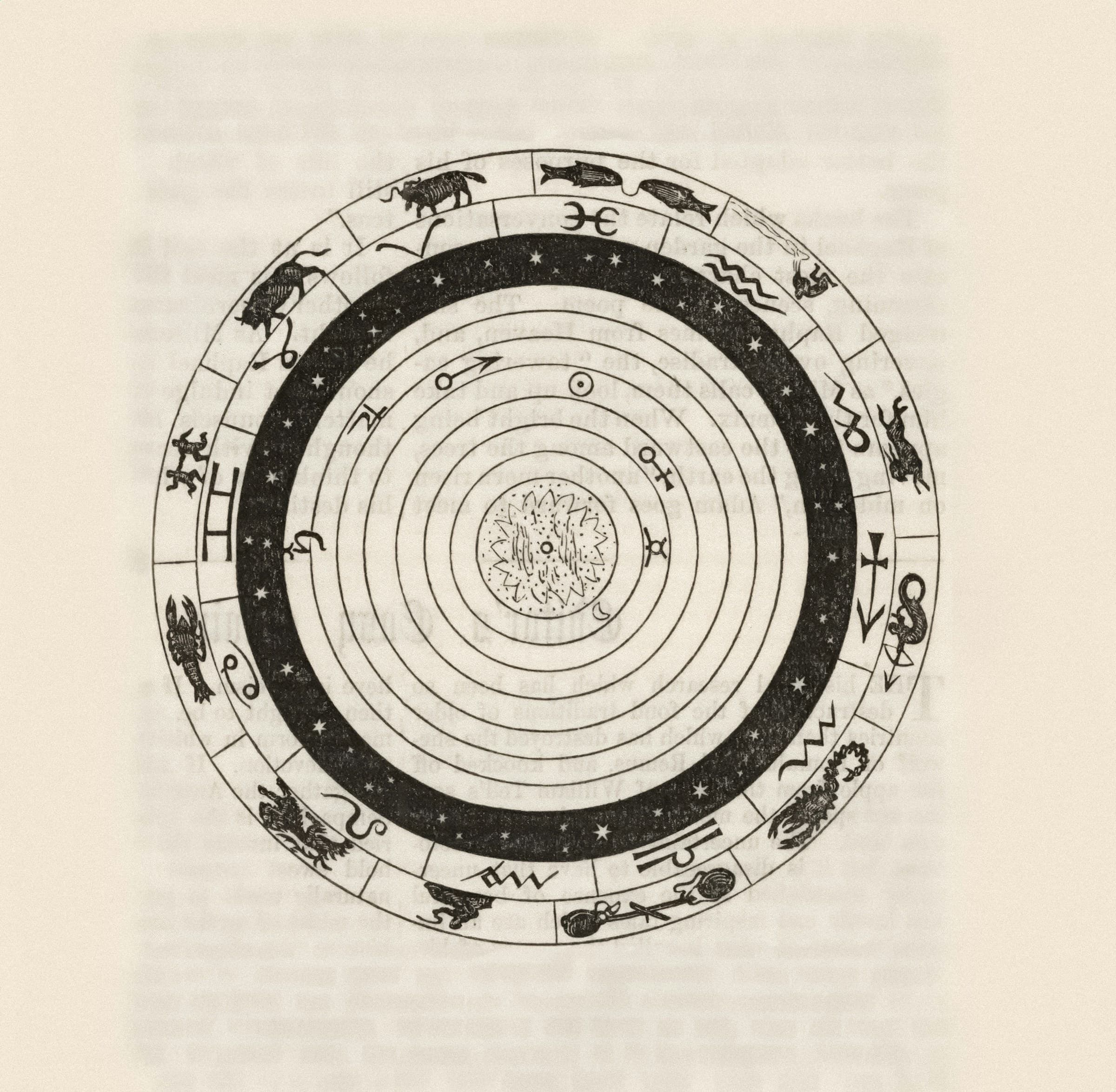
The R next to a planet indicates that, at the instant of your birth, it seemed to move backward in the sky, as seen from Earth. In the birth chart, KP does not treat this as a loss or as harm. K. S. Krishnamurti wrote that, in the birth chart, it makes no difference whether the planet is direct or retrograde, and that a retrograde planet neither loses strength nor does harm (KP Reader VI, p. 145). Retrogradation counts somewhere else in the method: in horary astrology.
What retrograde motion is
The planets orbit the Sun at different speeds. When Earth overtakes Mars, Jupiter or Saturn in its orbit, these planets seem to move back against the background of the stars for a few weeks or months. Mercury and Venus do the same in the phases when they pass between Earth and the Sun. The backward movement is apparent. The orbit keeps going in the same direction.
The Sun and the Moon are never retrograde. Rahu and Ketu, the nodes of the Moon, always move in the opposite direction to the planets, and that is why Krishnamurti says not to count them as retrograde (KP Reader VI, p. 146). In KP, retrogradation applies to five planets: Mars, Mercury, Jupiter, Venus and Saturn.
What the tradition says
Classical Vedic astrology measures the strength of the planets with a six-part system, Shadbala, and has its own rules for retrograde planets. A retrograde planet is considered strong. An exalted planet that turns retrograde loses strength, and a debilitated planet that turns retrograde gains strength (KP Reader VI, pp. 144 and 145).
Krishnamurti records these rules carefully and takes a different path. For him, a planet's strength does not say whether the result will be good (KP Reader VI, p. 145). In KP, what decides is the star the planet is in and the houses it signifies.
In the birth chart, the R does not deny
The book's example is of people born between March and May 1922. They had Jupiter and Saturn retrograde in Virgo, together with Rahu, and many went through the periods of Jupiter and Saturn. They studied, married, had children, bought a car and a house. Krishnamurti asks whether the retrograde planets denied anything because they were retrograde, and answers that they did not (KP Reader VI, p. 145).
If you were born with Saturn retrograde, KP reads that Saturn the way it reads any planet: by the star it is in, by the houses it occupies and rules, and by the sub.
Where retrogradation counts: in horary
In horary, the chart cast for the moment of a question, the rule changes (KP Reader VI, p. 146):
- A retrograde planet in the star of a direct planet: the matter comes through after obstacles and delay, when the planet turns direct again and moves past the point where the retrogradation began.
- A retrograde planet in the star of another retrograde planet, or in its own star: the promise fails.
- A direct planet in the star of a retrograde planet: success does not come either.
The book applies this to marriage. If the question is about marrying a specific person and the sub-lord of the 7th cusp is in the star of a retrograde planet, that marriage does not happen. Krishnamurti makes a point of adding that this does not mean the person will never marry (KP Reader VI, p. 146). The rule answers the question that was asked.
The same logic appears in the Ruling Planets, the rulers of the moment of the consultation. From the list, any planet in the star of a retrograde planet is discarded (KP Reader VI, p. 138). The post on Ruling Planets shows the full list.
The natal R and today's retrograde
The R in your chart stays there forever, because it describes the instant of birth. A planet that is retrograde in the sky today is a transit, a different matter. A natal retrograde Saturn stays retrograde in the chart when Saturn in the sky turns direct again. And someone born with Mercury direct goes through every transiting Mercury retrograde like anyone else.
In transit, a retrograde planet can cross the same degree three times. The post on transits and Gochara explains how KP uses these passages, and the one on Mercury retrograde covers the most famous case.
How Vedik handles retrograde planets
Vedik's engine follows the book's rule. In the birth chart, a retrograde planet neither denies nor delays a promise. When it calculates the Ruling Planets, the engine discards the ruler that is in the star of a retrograde planet, as Reader VI instructs. The position and motion of each planet come from the Swiss ephemeris.
To see your chart handled with this care, create your free reading.