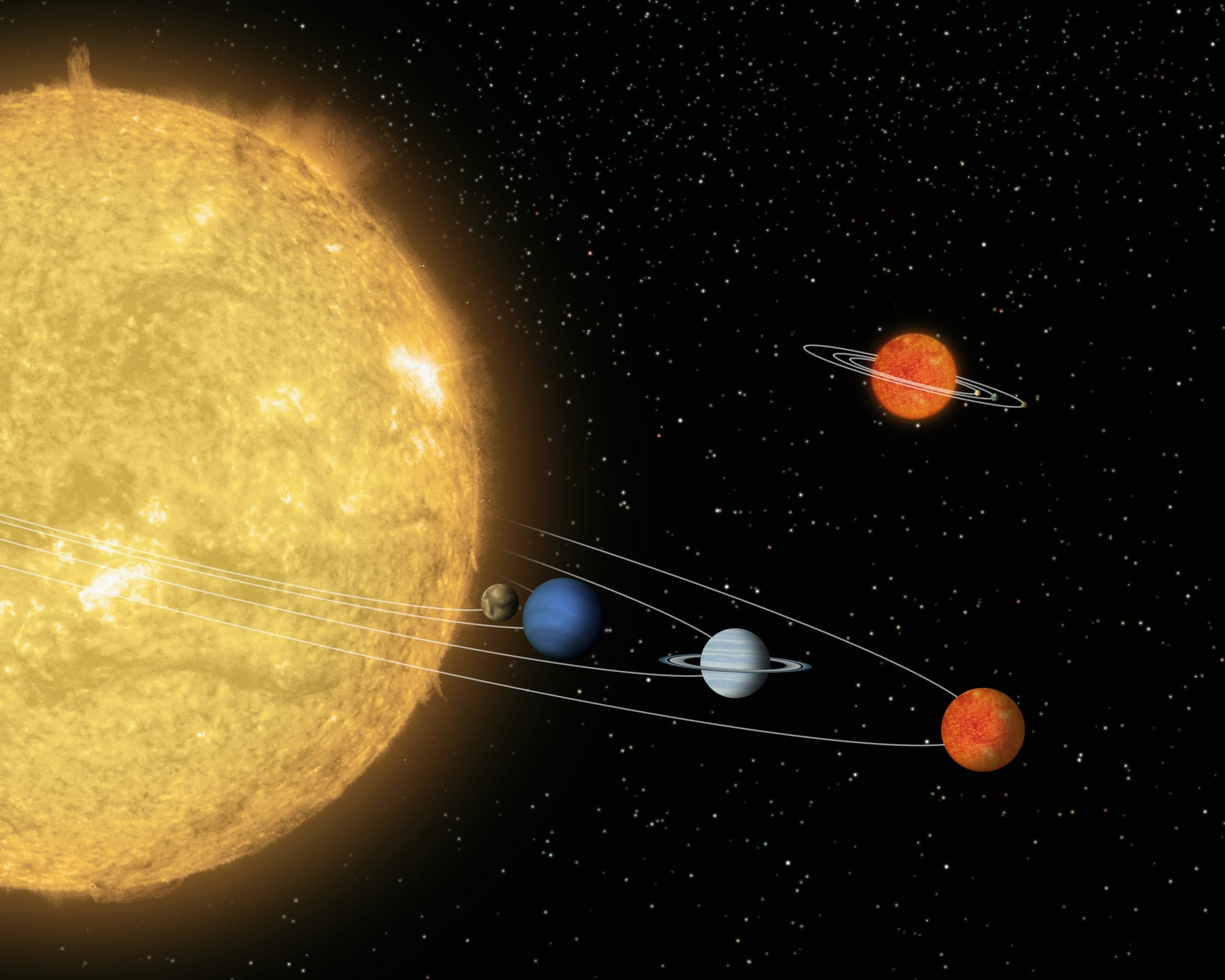
Vedic astrology works with nine planets, the grahas: Sun, Moon, Mars, Mercury, Jupiter, Venus, Saturn, Rahu and Ketu. The first seven are visible bodies. Rahu and Ketu are the nodes of the Moon, the two points where the Moon's orbit crosses the path of the Sun. Uranus, Neptune and Pluto are not part of the traditional system.
What the tradition associates with each planet
Krishnamurti, creator of the KP method, records two old images from the Indian tradition to explain the planets (KP Reader II, p.347 and 348).
In the first, the sky is the body of a cosmic being. The Sun is the soul, the Moon is the mind, Mercury is speech, Mars is strength, Jupiter is knowledge and happiness, and Venus is desire.
In the second, the planets form a royal court. The Sun is the king and the Moon is the queen. Jupiter and Venus are the advisers. Mercury is the young prince, Mars is the commander and Saturn is the servant.
How long each planet's period lasts
Each planet rules a period of your life, in the 120-year Vimshottari cycle (KP Reader I, p.104). The order and the length are always the same:
| Planet | Period |
|---|---|
| Ketu | 7 years |
| Venus | 20 years |
| Sun | 6 years |
| Moon | 10 years |
| Mars | 7 years |
| Rahu | 18 years |
| Jupiter | 16 years |
| Saturn | 19 years |
| Mercury | 17 years |
The planet that starts the sequence depends on the star the Moon was in at your birth. See how to know which phase you are in.
What each planet delivers in your chart
The image from the tradition describes the nature of the planet. What it brings to your life, in the KP method, depends on something else: the houses of your chart it represents. The same Jupiter can be about career in one chart and about moving to another city in another.
Krishnamurti writes that the result comes when the planets ruling the period are significators of the houses of the matter (KP Reader VI, p.189). That is why the reading of a period starts from your chart, and not from a fixed list of what each planet does. See more in house significators.
How the planets appear at Vedik
In Vedik's reading, each period has a name, such as "Consolidation and results" for Saturn or "Expansion and opportunities" for Jupiter. Each phase's name is Vedik's. What it brings to each subject comes from your chart.
To go deeper, read about Rahu and Ketu, about retrograde planets and about what each period brings.